

Samsung Washer Repair in Kissimmee, FL
Kissimmee's water supply from the Floridan Aquifer carries mineral content that accumulates in washing machine components, reducing efficiency and shortening the lifespan of drum seals and inlet valves. Stokes Appliance Repair connects Samsung washer owners throughout Kissimmee—including neighborhoods like Mill Run, Buenaventura Lakes, and Historic Downtown Kissimmee—with local independent repair providers who diagnose mineral damage, clean or replace affected parts, and restore reliable performance. Fast local access means your washer gets back to work without weeks of downtime.
Samsung Washer Repair for Kissimmee Homeowners
Kissimmee's water supply, drawn from the Floridan Aquifer, carries mineral content that builds up inside washing machine components over time, reducing efficiency and triggering unexpected breakdowns. Combined with the region's pattern of severe electrical storms during summer and fall months—events that send power surges through home circuits—Samsung washers in Kissimmee face real operational stress. Mineral deposits clog inlet valves and drum seals, while electrical stress can damage control boards and motor circuits. When a Samsung washer fails, the appliance sits idle and laundry backs up fast. Quick, targeted Samsung Washer Repair is essential to restore normal household function.
Stokes Appliance Repair connects Kissimmee homeowners with local independent providers who diagnose Samsung washer problems thoroughly and repair them right the first time. Whether the issue stems from hard-water mineral accumulation, electrical damage, drum bearing wear, or pump failure, the technicians who serve Kissimmee understand Samsung's design and work methodically to pinpoint the root cause. You'll get a clear explanation of what failed and why, realistic repair options, and prompt follow-up to ensure the washer runs reliably. When you need Samsung Washer Repair in Kissimmee, a local provider is ready to help.
Common Samsung Washer Error Codes
Of the twelve codes below, seven usually come down to something you can check yourself — a blocked filter, a kinked hose, a door that isn't latching. The other five point to a part inside the machine that needs a technician.
Samsung Washer 4C
Often clearable without a technician
What it means: The washer asked for water and did not get what it expected, so it has stopped rather than run a cycle dry. Samsung shows this as 4C on newer panels, 4E on older ones and nF on some models — one fault, three displays.
Why it happens: Almost always something before the machine rather than inside it: a supply tap not fully open, a kinked fill hose behind the unit, or the small mesh screens where the hoses meet the washer silted up with scale and grit.
What you can check: Check both taps are fully open, then pull the machine out far enough to see the fill hoses are not kinked. If that looks fine, turn the taps off, unscrew the hoses at the machine end and look at the inlet screens for debris.
When to call someone: If the supply is good and the screens are clear, the inlet valve on the machine is next, and that is where it stops being an owner check.
Samsung Washer Ub
Often clearable without a technician
What it means: The load has gone off balance in the tub and the washer will not spin it at speed, because an unbalanced drum at spin speed can damage the machine.
Why it happens: Usually one heavy item on its own — a towel, a bath mat, a single pair of jeans — or a load that has twisted into a rope on one side of the drum.
What you can check: Open the door, redistribute the load by hand and restart the spin. Adding a couple of similar-weight items often settles it; washing one heavy item alone rarely spins well.
When to call someone: If it trips on every load including well-balanced ones, the suspension or the sensor reading the drum may need looking at.
Samsung Washer 4E
Often clearable without a technician
What it means: The same not-filling fault as 4C, shown as 4E on older Samsung panels.
Why it happens: A closed or partly closed tap, a kinked fill hose, or blocked inlet screens where the hoses connect.
What you can check: Work from the wall in: taps fully open, hoses unkinked, then the inlet screens at the machine end.
When to call someone: If water reaches the machine freely and it still will not fill, the inlet valve needs testing.
Samsung Washer SE
Often clearable without a technician
What it means: Water is not leaving the machine at the rate the cycle expects, or is not leaving at all. Shown as 5E, SE, 5C or nd depending on the panel.
Why it happens: The debris filter at the bottom front catches coins, hair grips and lint and eventually packs solid. A kinked drain hose or a standpipe that cannot take the flow does the same thing from further down the line.
What you can check: Open the small flap at the bottom front, drain the residual water into a tray and clean the filter. Then check the drain hose behind the machine for kinks and that it is not pushed too far into the standpipe.
When to call someone: If the filter is clean and the hose run is clear, the drain pump itself needs testing.
Samsung Washer UE
Often clearable without a technician
What it means: The same unbalanced-load condition as Ub, shown as UE on some Samsung models.
Why it happens: A single heavy item, or a load that has bunched to one side of the drum.
What you can check: Redistribute the load by hand and restart the spin.
When to call someone: If balanced loads also trip it, the drum suspension is worth checking.
Samsung Washer dC
Often clearable without a technician
What it means: The washer cannot confirm the door is shut and locked, so it will not start or will stop mid-cycle.
Why it happens: Most often laundry caught in the door seal stopping it closing flush, or a door that has been slammed rather than pushed shut.
What you can check: Open the door fully, clear anything caught around the seal, and close it firmly without forcing it. Check the latch and the strike plate for anything obstructing them.
When to call someone: If nothing is obstructing it and the lock still will not engage, the door lock assembly is the usual cause.
Samsung Washer SUd
Often clearable without a technician
What it means: The washer has detected far more foam than the drum is designed to handle, and is pausing to clear it before continuing.
Why it happens: Usually too much detergent, or a standard detergent used in a high-efficiency machine, which foams several times more than an HE formula.
What you can check: Let the machine run its own suds-clearing routine rather than cutting the cycle short. Next load, reduce the dose and check the detergent is HE-rated if your machine needs one.
When to call someone: If it appears with a correct HE dose, something may be holding water in the drum and it is worth having checked.
Samsung Washer 5C
Often clearable without a technician
What it means: The same not-draining fault as 5E and SE, shown as 5C on some Samsung panels.
Why it happens: A packed debris filter at the bottom front, a kinked drain hose, or a standpipe that cannot take the flow.
What you can check: Clean the filter behind the flap at the bottom front, draining the residual water into a tray first, then check the hose run behind the machine.
When to call someone: If the filter is clean and the hose is clear, the drain pump needs testing.
Samsung Washer nF
Often clearable without a technician
What it means: The washer is not filling — the same fault Samsung shows as 4C and 4E on other panels.
Why it happens: A tap that is not fully open, a kinked fill hose, or the inlet screens where the hoses meet the machine blocked with scale and grit.
What you can check: Check both taps, straighten the hoses, then turn the taps off and inspect the inlet screens at the machine end.
When to call someone: If water reaches the machine freely and it still will not fill, the inlet valve is next.
Samsung Washer OE
Usually needs a technician
What it means: There is more water in the tub than there should be, so the washer has stopped filling and is trying to pump out.
Why it happens: Normally the inlet valve passing water when it has been told to close, rather than anything to do with the load or detergent.
What you can check: Turn the supply taps off at the wall so no more water can arrive. There is no owner-side fix for a valve that will not shut.
When to call someone: Promptly — a valve stuck open is a flood risk as well as an error code.
Samsung Washer 0E
Usually needs a technician
What it means: The same overfill condition as OE, shown with a zero on some panels.
Why it happens: An inlet valve letting water through when it should be closed.
What you can check: Shut the taps at the wall to stop the fill. Nothing else here is an owner check.
When to call someone: Promptly, for the same reason as OE.
Samsung Washer ddC
Often clearable without a technician
What it means: The AddWash door — the small hatch in the main door — is not registering as closed and latched.
Why it happens: It is easy to push shut without seating the catch, and a trapped sock or glove will stop it closing flush.
What you can check: Open the AddWash door fully, clear anything caught in it, and press it closed until the catch engages.
When to call someone: If it is properly shut and still reads open, the hatch switch needs checking.
Samsung Washer HE
Usually needs a technician
What it means: A fault in the heater circuit, so the machine cannot bring the wash water up to the temperature the cycle asked for.
Why it happens: A component failure rather than anything that builds up, so it usually appears without warning.
What you can check: Nothing here is an owner check — the heater and its circuit are inside the machine.
When to call someone: When you see it. Cold-water cycles may still run, but the machine is not doing what the programme selected.
Samsung Washer 5E
Often clearable without a technician
What it means: The same not-draining fault Samsung shows as SE and 5C on other panels.
Why it happens: A packed debris filter at the bottom front, a kinked drain hose, or a standpipe that cannot take the flow.
What you can check: Open the flap at the bottom front, drain the residual water into a tray and clean the filter, then check the hose run.
When to call someone: If the filter and hose are clear and it still will not drain, the drain pump needs testing.
Samsung Washer LE
Usually needs a technician
What it means: Moisture has been found somewhere inside the machine it should not be — a leak, not a setting.
Why it happens: Water escaping from a hose connection, a seal or the tub reaches a sensor that shuts the cycle down.
What you can check: Turn the supply taps off at the wall and stop using the machine. The code says water is escaping but not from where.
When to call someone: This needs a technician — tracing the source means getting behind or under the machine.
Samsung Washer 3E
Usually needs a technician
What it means: A motor fault — the drive is not behaving the way the control expects.
Why it happens: A failure in the motor or its control circuit rather than anything to do with the load or detergent.
What you can check: Nothing here is an owner check. A single power-cycle at the breaker clears a one-off glitch; a code that returns is real.
When to call someone: If it comes back after a power cycle, the motor circuit needs testing.
| Code | What it means |
|---|---|
| Ub / UE / U6 | The load is unbalanced inside the tub, so the washer cannot spin it safely. |
| 5E / SE / 5C / nd | Water is not draining at the rate it should, or is not draining at all. |
| dC / dC1 / dL | The door is not being detected as closed and locked, so the cycle will not run. |
| SUd / Sd | An over-sudsing condition has been detected and the machine is pausing to let the foam clear. |
| OE / 0E / OC | There is too much water in the washer, which normally means the inlet valve is passing water when it should be shut. |
| LE / 1C | Moisture has been detected somewhere inside the machine that it should not be, which is a leak rather than a setting. |
| HE / HC | A fault in the heater circuit, so the machine cannot bring the water up to temperature. |
| 3E / 3C | A motor fault — the drive is not behaving as the control expects. |
| tE / tC | The temperature sensor is reporting a reading outside the range the cycle allows. |
| bE2 / 6E2 | A button on the control panel is reading as stuck or continuously pressed. |
Don't see your code? Call (407) 883-7780 — we'll help you track it down.
Common Samsung Washer Problems We Fix
Won't Drain
A clogged drain filter, kinked hose, or pump failure often stops water from leaving the tub. The local provider Stokes Appliance Repair connects you with will diagnose whether it's debris buildup or a mechanical fault and restore drainage.
Leaking Water
Worn door seals, loose inlet hoses, or internal seal damage commonly cause pooling water around or under your washer. A local provider in the Stokes Appliance Repair network can identify the leak source and recommend the right repair.
Not Spinning
A faulty drum bearing, belt wear, or motor issue may prevent the drum from turning during the spin cycle. The independent provider you're connected with will test the mechanical components and address what's stopping rotation.
Won't Start
Control board glitches, a broken door latch, or power supply problems often keep the cycle from beginning. Stokes Appliance Repair links you with a local technician who will check electronics and safety switches to get your washer running again.
Loud or Vibrating
Foreign objects stuck between the drum and tub, worn suspension components, or an unbalanced load create banging or shaking. A provider in the Stokes network will inspect for blockages and worn parts to eliminate the noise.
Error Code on Display
Samsung washers display codes like 4C to signal drain issues, sensor failures, or communication errors between parts. The independent local provider Stokes Appliance Repair connects you with will read the code and resolve the underlying problem.
Why Kissimmee Homeowners Choose Stokes for Samsung Washer Repair
Samsung Washer Repair by Local Experts
Stokes connects you with independent providers who know Samsung washers inside and out. Fast local response means your laundry backlog doesn't pile up. Repair work happens on your schedule, not weeks away.
Clear Communication on Samsung Washer Fixes
The independent provider assigned to your Samsung washer repair explains what's wrong and why before starting work. You'll understand the repair plan and cost upfront. No surprises, no guesswork—just straightforward service.
Thorough Samsung Washer Repair & Diagnosis
Samsung washers need proper diagnosis to fix the real problem, not just a symptom. The local provider Stokes connects you with inspects thoroughly and addresses root causes. Your washer runs reliably once the repair is complete.
Samsung Washers & Hard Water Concerns
Kissimmee's hard water accelerates mineral accumulation inside washing machines, including Samsung models. A local independent provider familiar with regional water chemistry can identify buildup damage and prevent premature failure through proper Samsung washer repair and maintenance guidance.
How Our Repair Service Works
Schedule Your Samsung Washer Repair Visit
Contact Stokes Appliance Repair and describe your Samsung washer's issue—whether it's a drainage problem, drum failure, or electronic malfunction. A local independent repair provider in Kissimmee will confirm availability and arrange a time that works for you.
Technician Diagnoses Your Samsung Washer
The provider inspects your Samsung washer to identify the root cause, checking components like the pump, motor, control board, and seals. In Kissimmee's hard water environment, mineral deposits can restrict water flow and strain internal parts—a factor the technician will evaluate.
Repair Completed and Tested
Once the issue is confirmed, the independent provider repairs or replaces the faulty Samsung washer component and runs a test cycle to verify normal operation. You'll receive an explanation of what was done and guidance on keeping your Samsung washer running smoothly.
Need appliance repair in Kissimmee? Our technicians can help fast.
Call (407) 883-7780Samsung Washer Repair FAQ — Kissimmee, FL
Samsung Washer Repair addresses issues like drum problems, water leaks, cycle failures, and drainage troubles. A local independent provider will diagnose the specific malfunction, replace worn seals or pump components if needed, and test the unit before finishing. The scope depends on what's causing the breakdown—some repairs are straightforward, while others require parts replacement.
Stokes Appliance Repair connects you with independent local providers in the Kissimmee area who typically respond within hours or the next business day. Once you contact a provider through our referral service, they'll schedule an appointment that fits your availability. Response times vary by provider workload, but local coverage means you won't wait long for an assessment.
Repair costs depend on what's broken—diagnostic time, parts needed, and labor all play a role. A simple hose replacement costs far less than a new drum assembly or control board. The independent provider you're connected with will explain the issue and pricing before beginning work, so there are no surprises.
Clear the area around your washer so the technician has room to work and can access water connections if needed. Note any unusual sounds, error codes, or when the problem started—this information helps the provider diagnose faster. Make sure the washer is empty and powered off before the appointment.
Run cleaning cycles regularly to reduce mineral buildup inside the drum and pipes, which is especially important in Kissimmee where local water contains higher mineral levels. Don't overload the machine, use the correct detergent amount, and inspect hoses for cracks or bulges every few months. Catching small problems early prevents bigger, costlier repairs later.
Kissimmee's frequent lightning storms and power surges during summer months can damage washer control boards and electronic components. If your washer stops working after severe weather, have a provider check for power-related damage. Protecting your appliance with a surge protector and unplugging during storms helps reduce risk.
Samsung Washer Repair Across Kissimmee
Samsung washers in Kissimmee face a particular challenge tied to the area's water chemistry. The local municipal water supply, drawn from the Floridan Aquifer, carries minerals that build up inside washing machine components over time. This mineral accumulation slows drainage, reduces cleaning efficiency, and can eventually lead to costly repairs or premature failure. Homes throughout Kissimmee—whether in established neighborhoods like Historic Downtown Kissimmee or newer subdivisions such as Reunion and Storey Lake—experience the same hard-water effects on their appliances. The harder the water, the more often Samsung washers need professional attention to remove scale and restore normal operation.
Beyond water quality, Kissimmee's weather patterns also take a toll on appliance electronics. Severe electrical storms are common during the warmer months, and the power surges that follow can damage the control boards and sensors that run modern Samsung models. When a washer suddenly stops mid-cycle or won't start, a power event may be to blame. Local appliance repair providers understand these regional pressures and can diagnose whether your Samsung washer needs descaling, electrical component replacement, or other weather-related repairs. Quick local service helps get your laundry routine back on track before mineral damage or electrical stress causes bigger problems.
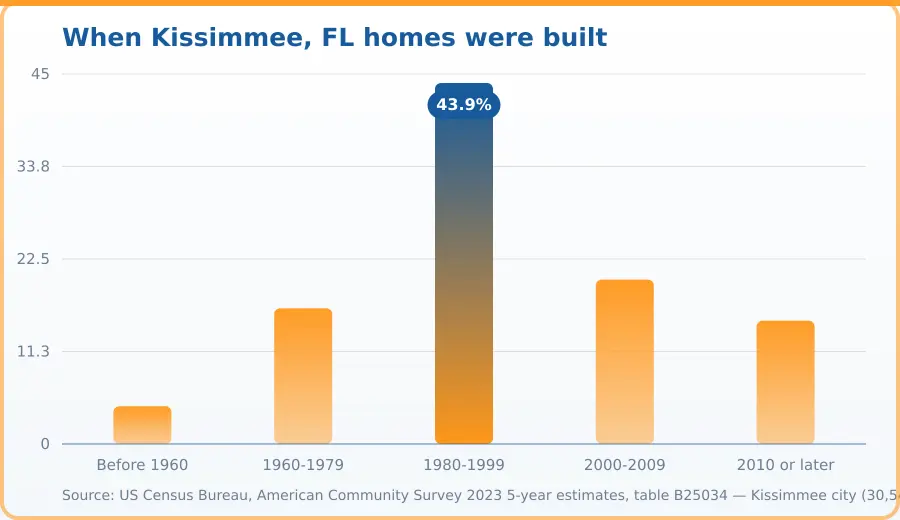
| Period | When homes were built (%) |
|---|---|
| Before 1960 | 4.6 |
| 1960-1979 | 16.5 |
| 1980-1999 | 43.9 |
| 2000-2009 | 20 |
| 2010 or later | 15 |
Source: US Census Bureau, American Community Survey 2023 5-year estimates, table B25034 — Kissimmee city (30,542 housing units). Retrieved October 4, 2026.
More Repairs for This Brand
More Ways We Can Help
Homeowner Safety Toolkit
Verify Your Kissimmee, FL Appliance Repair Company
Before you hire anyone, use these independent national resources to confirm credentials, standards, and track record.
BBB
Look up any appliance repair company's complaint history, customer reviews, and accreditation status — a free, independent check before you hire.
Check StandingEPA
Anyone who services a refrigerator, freezer, or other appliance containing refrigerant is legally required to hold EPA Section 608 certification. See what that actually requires.
Refrigerant Certification RulesISCET
NASTeC is the appliance repair industry's own national certification exam, administered by the nonprofit ISCET. It's voluntary, so it's worth asking whether your technician holds it.
About NASTeC CertificationBook your Kissimmee appliance repair today.
Call (407) 883-7780Our Kissimmee, Florida Service Area
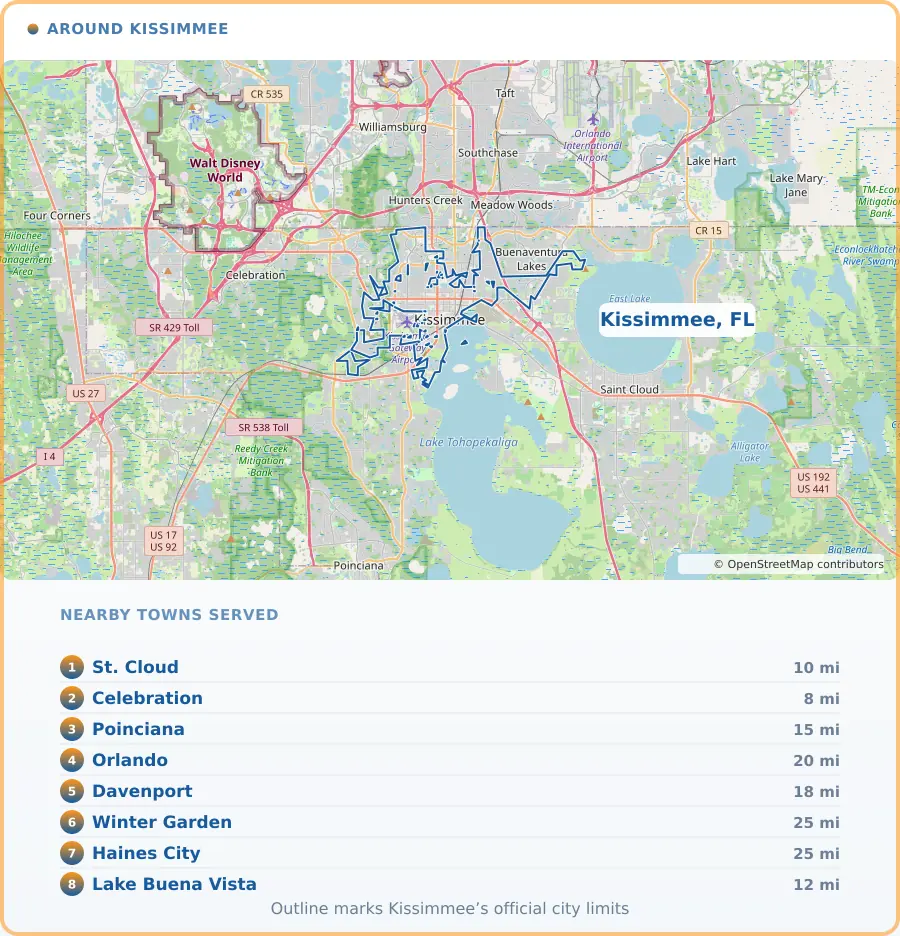
Based in Kissimmee, FL, with 8 nearby communities inside the service area — near enough to reach quickly, not just listed on a map.
About Kissimmee, FL
Just south of Orlando, Kissimmee lives in the shadow and the glow of Walt Disney World, and that proximity shapes nearly everything here. Tourism and hospitality drive the local economy, filling resorts, vacation rentals, and attractions with visitors year-round, while retail, healthcare, and construction keep pace with a city of roughly 80,000 that continues to add new neighborhoods. Employers like AdventHealth Kissimmee, Osceola Regional Medical Center, and the Osceola County School District anchor steady, home-grown jobs alongside the theme-park economy.
Beneath the modern growth, older Florida still shows through — cattle ranching remains part of the region's story, a reminder that this was agricultural land long before the crowds arrived. From the historic charm of Historic Downtown Kissimmee to newer communities like Storey Lake, the city blends small-town roots with big-destination energy.
Photo: Freeholdman12, CC BY 4.0